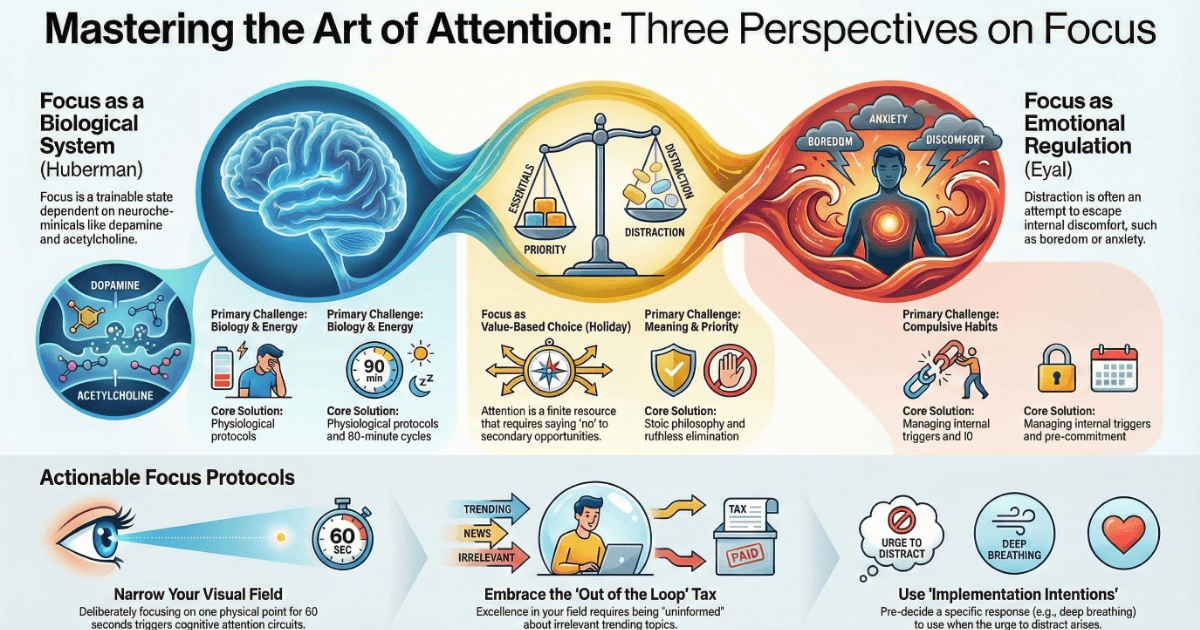
Focus is the ability to sustain attention on a chosen task while filtering out competing stimuli. It’s not the absence of distraction, but the deliberate management of attention over time. In a world engineered for fragmentation endless notifications, competing priorities, constant connectivity focus has become both rare and essential. Different creators approach focus from distinct perspectives: neuroscience, philosophy, and behavioural design.
Andrew Huberman’s Approach to Focus
Huberman approaches focus through the lens of neurobiology, explaining it as a trainable system dependent on specific neurochemicals and timing. Focus isn’t willpower alone it’s the result of how attention mechanisms in the brain are supported.
The brain requires three key neurochemicals for sustained focus: epinephrine (adrenaline) for alertness, acetylcholine to highlight relevant neural circuits, and dopamine to maintain motivation over time. These work together in roughly 90-minute cycles, during which focus naturally fluctuates. The beginning and end of these cycles involve transitioning in and out of concentrated states expecting perfect focus for the entire duration sets unrealistic expectations.
Key principles:
- Visual focus drives cognitive focus: deliberately narrowing visual attention (focusing on a single point for 30-60 seconds) strengthens the brain’s attention circuits
- Fasted versus fed states each support different types of focus work morning fasted work often suits linear tasks, while afternoon fed states better support creative thinking
- Deliberate cold exposure (cold showers, ice baths) increases epinephrine and dopamine, enhancing alertness for 60+ minutes
- After focused work bouts, defocusing practices (walking, non-sleep deep rest, deliberate mind-wandering) accelerate neural plasticity and learning
Huberman emphasizes that focus is not constant. Distraction during focus sessions is normal the practice lies in repeatedly redirecting attention back to the task. Building focus capacity requires deliberate practice, not just trying harder.
Related Content:
Ryan Holiday’s Approach to Focus
Holiday frames focus through Stoic philosophy, treating attention as a finite resource that must be allocated with intention. Focus improves when you accept that attending to one thing necessarily excludes everything else.
The Stoic approach emphasizes that being “out of the loop” on trending topics, news cycles, or cultural moments isn’t failuremit’s the price of excellence in what matters. Epictetus taught that you must be willing to appear foolish or uninformed in areas outside your chosen focus. This means tolerating FOMO, resisting the compulsion to stay current on everything, and recognizing that breadth of awareness often comes at the expense of depth of work.
Key principles:
- Focus requires saying no to most things not just bad opportunities, but good ones that don’t serve your primary aim
- Single-tasking is the only real productivity: attempting to do multiple things simultaneously ensures mediocrity in all of them
- Silence and stillness aren’t luxuries they’re prerequisites for hearing the internal voice that guides meaningful work
- External practices support internal focus: journaling clarifies what deserves attention, daily walks create space for thought, and physical simplicity (minimal environments, limited inputs) reduces decision fatigue
Holiday emphasizes that focus isn’t about techniques for concentrating harder in the moment. It’s about structuring your life so that fewer things compete for your attention in the first place. This requires identity-level decisions about what kind of person you’re becoming and what truly matters.
Related Content:
Nir Eyal’s Approach to Focus
Eyal approaches focus through behavioral design, arguing that distraction is driven not by external triggers but by internal discomfort. The inability to focus is often a symptom of trying to escape emotional states boredom, uncertainty, anxiety, or restlessness.
Most advice treats distraction as an external problem requiring willpower or discipline to overcome. Eyal reframes it: you can’t eliminate distractions, but you can become indistractable by managing the discomfort that makes distractions appealing. This involves identifying the internal triggers (feelings) that precede distracted behavior, then developing healthier responses to those feelings.
Key principles:
- Master internal triggers before addressing external ones understand what uncomfortable feeling precedes reaching for your phone, opening email, or context-switching
- Use implementation intentions to pre-decide responses to discomfort: “When I feel the urge to check social media, I will take three deep breaths and return to my document”
- Timeboxing creates focus by assigning specific time blocks to specific activities, including time for distraction (scheduled social media breaks reduce their pull during focus blocks)
- Make distraction harder through effort pacts (removing apps, using website blockers) and identity pacts (defining yourself as someone who honors commitments)
Eyal’s framework distinguishes between traction (actions that move you toward your goals) and distraction (actions that pull you away). Simple systems pre-commitment devices, social accountability, redesigned environments restore focus by addressing the root cause: the desire to escape how you feel in the present moment.
Related Content:
Common Themes Across Approaches
Despite different entry points, several patterns emerge across these creators:
Focus requires both structure and practice. Huberman emphasizes neural training through repeated practice, Holiday through life design and ruthless prioritization, and Eyal through behavioral systems that reduce friction. None treat focus as purely a mental willpower battle.
Internal state matters more than external circumstances. Huberman points to neurochemistry and circadian timing, Holiday to philosophical clarity about what deserves attention, and Eyal to emotional regulation. Each recognizes that forcing focus without addressing underlying conditions biology, values, or feelings is unsustainable.
Distraction is normal, not failure. All three acknowledge that attention naturally wanders. Huberman describes the neurological reality of fluctuating focus cycles, Holiday notes that even Stoics wrestled with competing demands, and Eyal explains distraction as the brain’s predictable response to discomfort.
Where to Go From Here
These creators approach focus from neuroscience, philosophy, and behavioral design each offering a distinct path depending on whether you’re struggling with biology (Huberman), meaning and prioritization (Holiday), or compulsive behaviors (Eyal). The approach that resonates most depends on your specific challenge: optimizing your brain’s attention systems, clarifying what deserves focus, or managing the discomfort that triggers distraction. Explore each creator’s full conversations through their respective summary posts to find the framework that addresses your situation.
This Concept Page is part of Creator Daily’s Personal Growth Desk – a curated reference library designed to help you understand ideas clearly and decide what’s worth your time.